Kyndryl brand standards
Brand voice
Overview
Our brand voice is the tone and personality that we embody when we communicate as Kyndryl. Grounded in our brand strategy, our brand voice remains consistent across all audiences and formats, helping to create a distinctive and memorable impression of our brand in a crowded market.
The Kyndryl Coach
At Kyndryl, our brand voice is the Kyndryl Coaching Voice. The Kyndryl Coach is not a sports coach but a business coach, intelligent, devoted and who works alongside our customers to take action and make progress together. No matter the audience or format, our writing should always reflect the voice of the Kyndryl Coach.
A great coach shares your vision, challenges you to grow and progress, and helps you to stay focused along the way. They're right beside you, encouraging, motivating and inspiring you to be your best. The Kyndryl Coach speaks with an authority and confidence born from experience: they know firsthand what it takes to set goals and navigate challenges effectively. Full of drive, they bring a sense of urgency, warmth and passion to the pursuit of excellence. Always positive and forward-thinking, they inspire progress at every step.
Our brand voice attributes
Our Kyndryl Coaching Voice is grounded in the following four attributes. While you have the freedom to dial attributes up or down depending on the content, all four should always be present to some degree.


Diving deeper into each attribute
Each of our four attributes leaves a distinct impression on the reader. Together, they shape our Coaching Voice, helping our writing feel intentional, consistent and unmistakably Kyndryl. Click through the attributes below to explore what each one means and how it shows up in practice.
- Magnetic and passionate
- Invested in you
- Expert & curious
- Savvy

Modulating our tone
Just as people adapt their tone to different situations while continuing to retain their core personality, our brand voice can flex and adapt to fit different situations and content types. While all four attributes should be present to some degree when writing for Kyndryl, feel free to dial them up or down to suit the context.
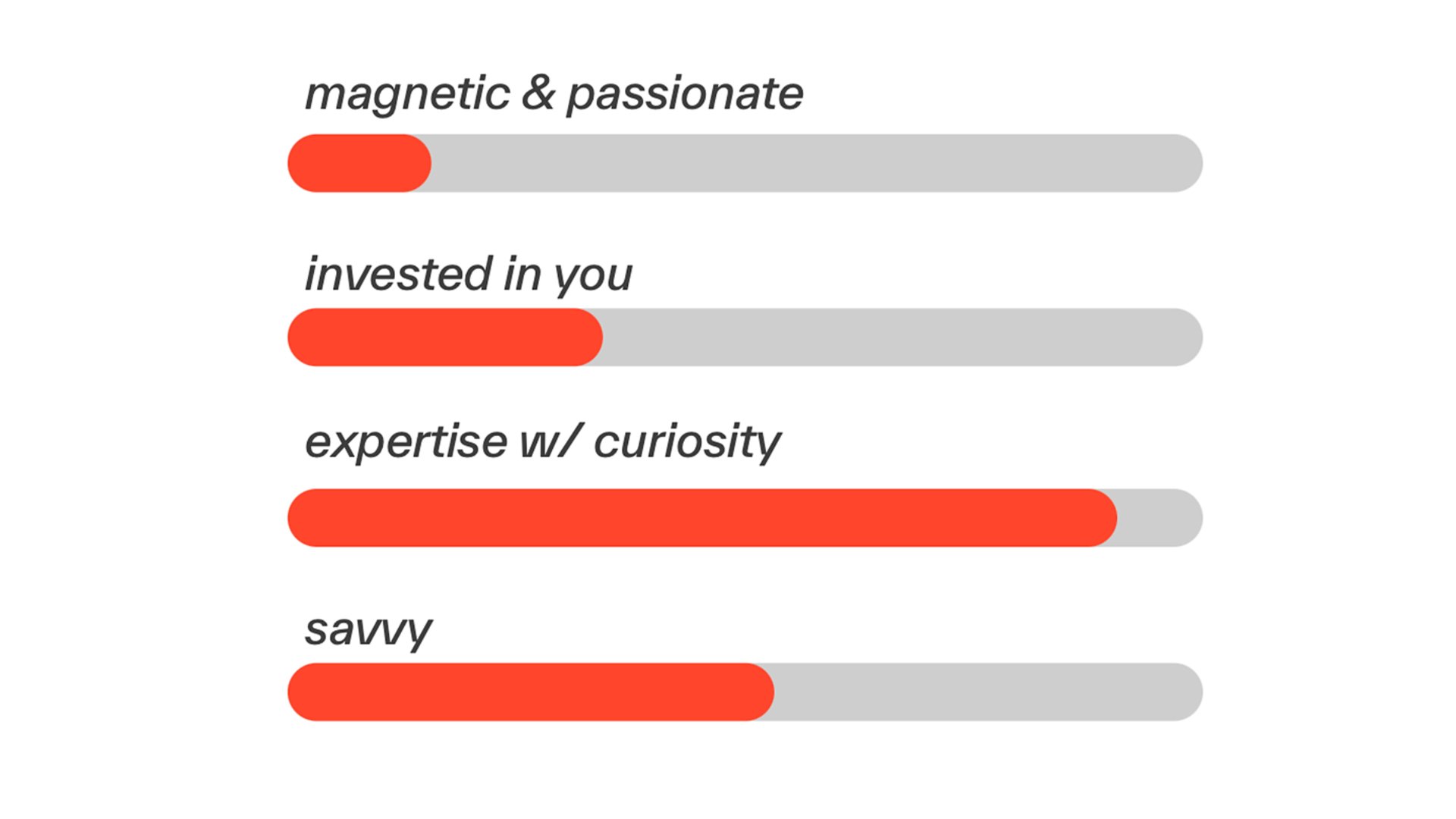
Sometimes we emphasize our expertise and curiosity
• Prospective customer meetings
• Thought leadership pieces
• Press releases
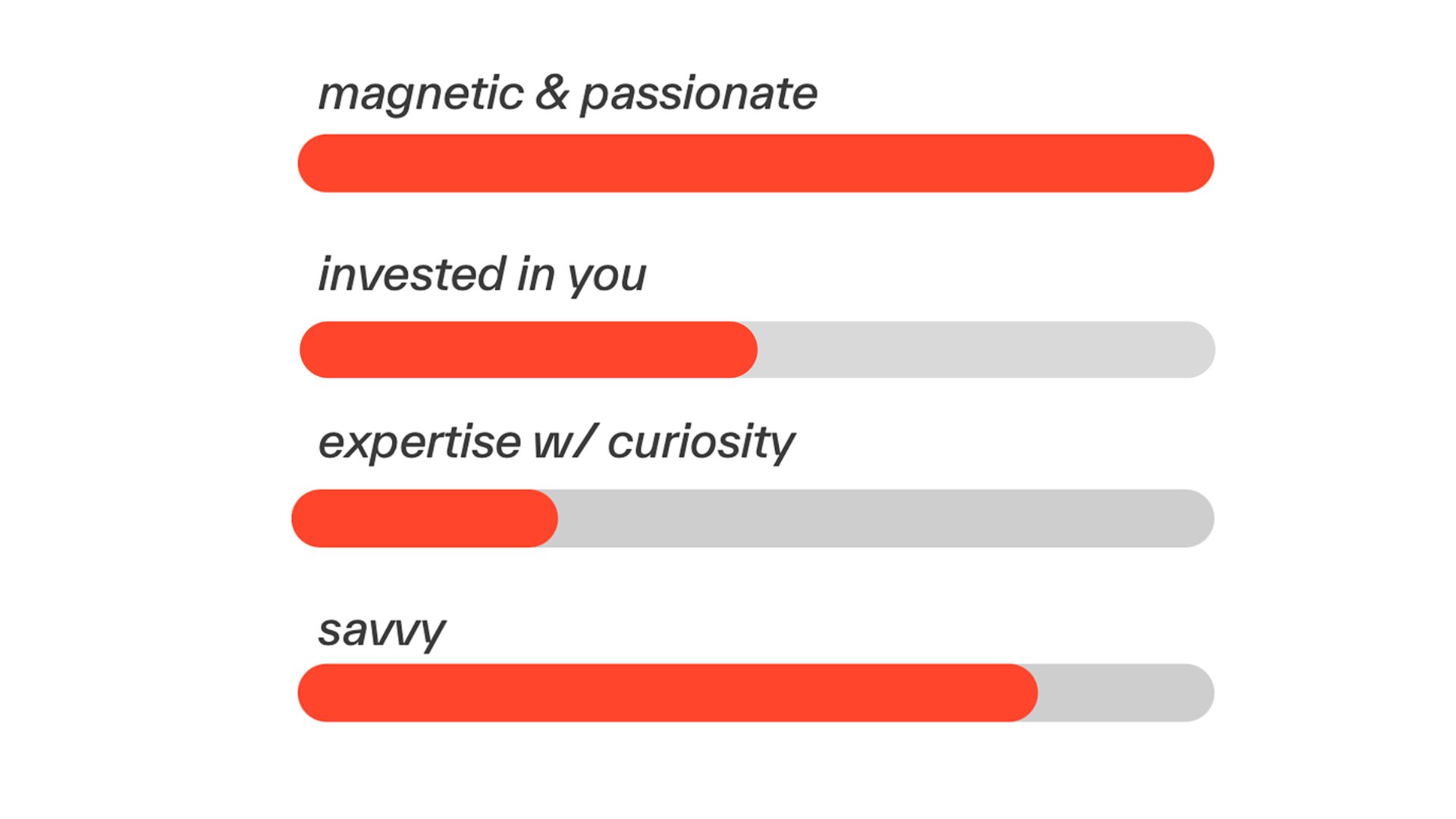
At other times, we dial up our magnetic and passionate side
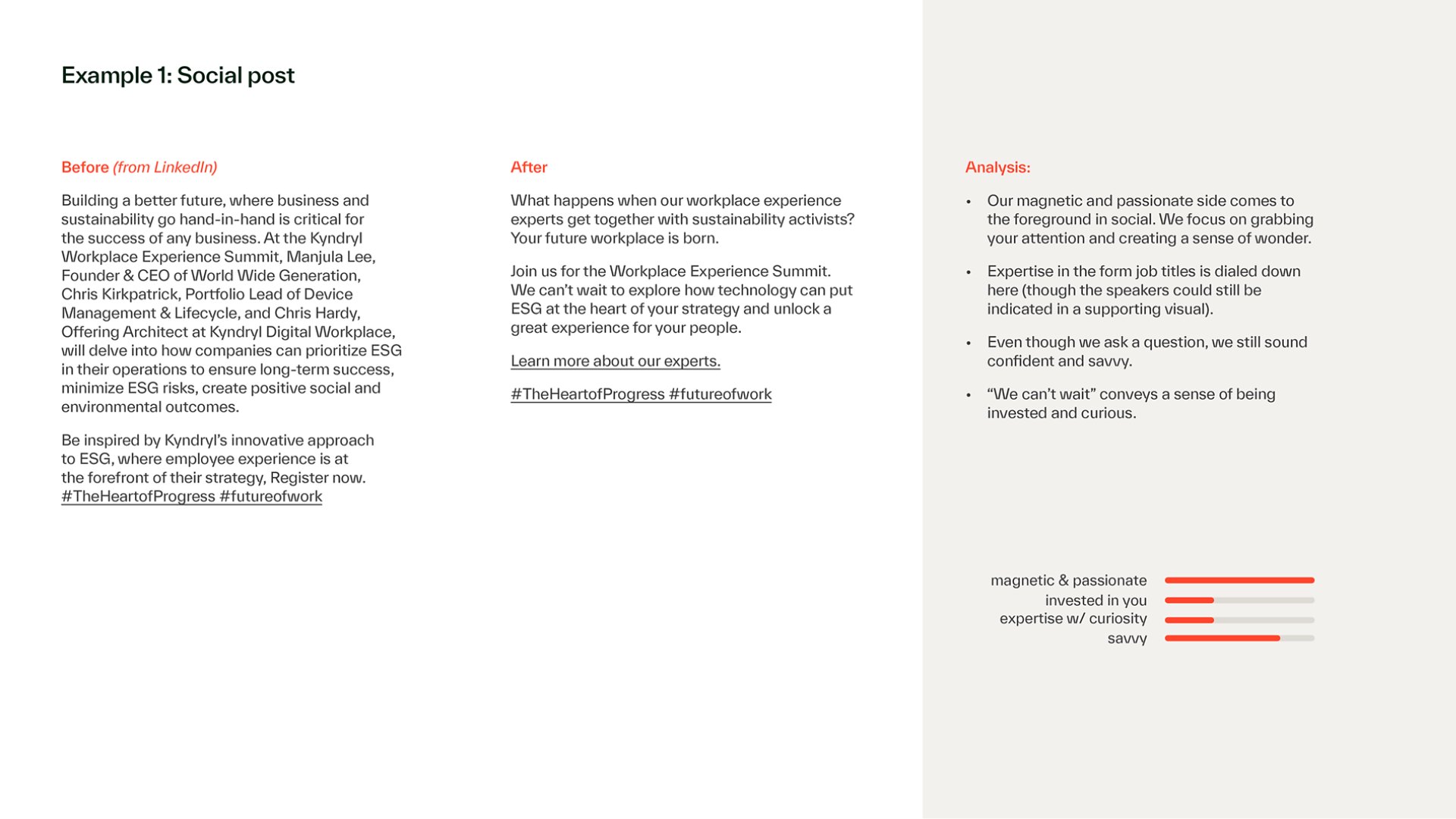
• Social media
• Advertising headlines
• Events
When we need to...
(For example, launching a new service or sharing news of an award)
Modesty shouldn’t prevent us from writing a compelling announcement. Consider the following ways our Coach can authentically speak with pride:
• We are invested in customer success, so it’s natural to point to what customers are saying and doing. Use a testimonial. Or celebrate what they’ve achieved with our help.
• We have a sense of curiosity, so prompt audiences to consider what might be possible now that this achievement is in place. Show excitement for what we might be able to build next.
• We’re savvy and understand our customers are in a competitive environment. Get them to wonder if they might be missing out. (For example, “What are 500+ customers learning about themselves through Kyndryl Bridge?”)
• Show our passion for what is now possible. This does not mean using exclamation points or showing surprise in our success, but instead showing emotion for the customer outcome.
(For example, communicating about an outage with a customer)
Coaches know how to acknowledge problems and then quickly
pivot to what’s possible next. Try one of these ideas:
• Lead with empathy that shows we understand and are invested, but never in a way that instills fear or dwells on the negative. Simply acknowledge the difficult situation and then move on to what can be done next.
• Acknowledge the reality of the situation simply and directly. Then position our expertise as part of the solution. (For example, “We see you have an outage. We know how to fix that — now let’s investigate your specific scenario.”)
• Show our devotion to progress by quickly connecting to what is possible next, or by identifying what we’re learning for next time.
(For example, discussing a new trend)
Be careful not to talk down to people. Instead, imagine yourself as a Coach who has learned by doing and passionately wants to share that knowledge with your team. For example:
• Show a personal investment in your topic. What’s at stake and why do you care?
• Even if it’s a complex subject, use everyday language and make it tangible for people in a real-world way.
• Pose an interesting (or even thought-provoking) question for the reader to consider. Draw them in before you explain every detail.
• Pair the practical with the vision statements. We aren’t just dreamers; we are doers and plan to carry new ideas through to fruition.
• Prove your point. Convince your audience with facts and data based on real-world observations.
• Use empathy to make your piece relevant. How does it connect with the life and needs of the reader? Is there an opportunity to say we heard you and have developed a solution to fit your needs?
(For example, limited space in a banner ad)
We can show how we think even in a small format by paying
careful attention to our word choice:
• Convey that we are working together with customers as one team.
• Make a declarative statement that contains a point of view.
• Pose an intriguing question in a headline.
For example:
Co-creation is about listening.
Where will AI take your business?
Our customers move the world.
No wonder we’re so devoted to their systems.
Infrastructure choices are choices about the future of your business.
Let’s make them together.
Test your writing
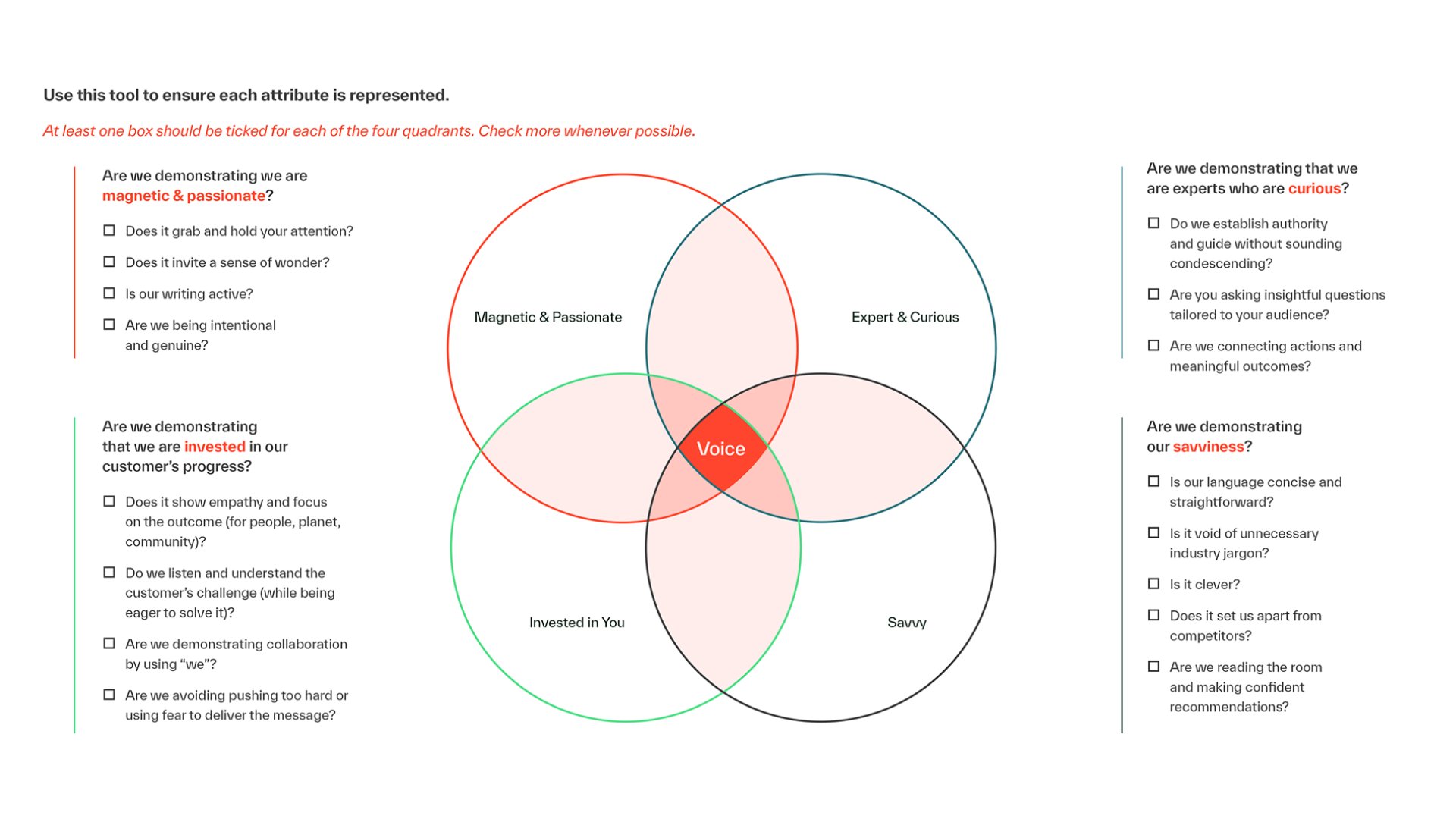
The Kyndryl Voice test is an easy way to double check that all four brand attributes are coming through in your writing. As you review your work, check to see if you are able to answer "yes" to at least one of the questions in each quadrant. If so, you are good to go! If not, it might be time for a rewrite.
Writing examples
Below, you can download a PDF of writing samples that show the Kyndryl Coaching Voice in action. Each page includes a before-and-after example, along with a brief explanation of what changed, why it changed and how each piece reflects our four voice attributes.